Transform overwhelm into clarity with a room-by-room system that honors your memories while designing a home—and life—that thoughtfully aligns with your present reality.
Downsizing represents one of life’s most meaningful transitions—a conscious choice to reshape your environment around evolving needs, values, and aspirations. Far beyond reducing square footage, this journey invites intentional curation of possessions, routines, and daily rhythms. This guide offers a carefully structured framework informed by observed patterns in successful transitions, principles of spatial psychology, and practical moving logistics. Whether you’re embracing minimalist living, navigating retirement, adapting to an empty nest, or seeking greater flexibility, this strategy transforms uncertainty into purposeful action. You’ll discover not just how to sort belongings, but why certain approaches ease emotional friction, when to involve others thoughtfully, and what spatial choices cultivate comfort in compact living. This isn’t about loss—it’s about creating space for clarity, calm, and what matters most to you today.
Introduction: Redefining Downsizing Beyond “Less Stuff”
For decades, downsizing carried connotations of limitation or regression. Today’s intentional downsizers—from young professionals choosing urban apartments to retirees prioritizing mobility—reframe this narrative entirely. Downsizing is increasingly recognized as a proactive design choice: sculpting environments that support well-being, reduce maintenance demands, and amplify daily joy. Research consistently links cluttered environments to heightened stress and decision fatigue, while organized, purposeful spaces tend to foster mental clarity and emotional ease. Real estate trends reflect growing interest in thoughtfully scaled living, often driven by conscious lifestyle values rather than constraint alone.
Yet the emotional landscape remains deeply personal. Sorting through objects imbued with memory—children’s artwork, inherited furniture, travel mementos—naturally evokes reflection, identity questions, and complex family dynamics. Dismissing these feelings as mere “clutter” undermines the process. True downsizing strategy integrates practical logistics with psychological awareness. It acknowledges that a set of wedding china holds meaning beyond function; a workshop full of tools reflects capability and care. The most sustainable transitions honor this duality: respecting the past while consciously designing the future.
This guide synthesizes spatial awareness, change management principles, and real-world moving considerations into a unified system. You’ll find no judgmental mandates or extreme prescriptions. Instead, we offer a flexible, compassionate framework adaptable across diverse scenarios: cross-country relocations, aging-in-place adaptations, life transitions, and voluntary simplicity journeys. Every recommendation centers your definition of “enough.” Whether your new space is a compact studio or a gently reduced family home, this strategy meets you with patience, practicality, and profound respect for the human experience embedded in your belongings. The journey begins not with boxes, but with clarity.
The Intentional Downsizing Framework: Prepare, Sort, Transition
Forget chaotic weekend purges or last-minute packing rushes. Sustainable downsizing follows a deliberate three-phase rhythm designed to build confidence and reduce overwhelm. This framework transforms a complex project into manageable, meaningful steps. Each phase creates psychological safety while generating tangible progress. Rushing preparation to “start sorting” is a common pitfall—often leading to fatigue, regretted decisions, or stalled momentum. Honor the sequence. Your future self will thank you.
Phase 1: Prepare – Laying the Emotional and Logistical Foundation (Weeks 4–8 Before Move)
Preparation is strategic investment, not delay. Skipping this phase often amplifies emotional strain during sorting. Thoughtful preparation creates a container where decisions feel intentional and supported.
Step 1: Clarify Your “Why” with Depth
Vague goals like “simplify life” lack staying power during challenging moments. Explore your motivation using reflective questioning:
– Why downsize? “To reduce home maintenance.”
– Why reduce maintenance? “To reclaim weekends for hiking with my grandchildren.”
– Why prioritize that? “To nurture intergenerational connection while I can.”
– Why does this resonate? “It aligns with my value of presence over possession.”
Write this refined “Why” statement. Place it where you’ll see it often—a kitchen cabinet, phone lock screen. When fatigue arises during sorting, this anchors you to purpose beyond square footage. Value-aligned intentions tend to sustain motivation through difficult choices. Your “Why” also guides tough calls: Does keeping this large entertainment center support “weekend hikes with grandkids”? If not, its path becomes clearer.
Step 2: Conduct a Reality-Based Space Assessment
Emotional attachment can cloud spatial judgment. Counter this with objective measurement:
1. Obtain floor plans of both current and future homes (request from realtor, landlord, or sketch to scale using graph paper or a floor plan app).
2. Measure major furniture pieces under consideration (sofa, bed, dining table), including clearance space needed for walking, opening doors, or using drawers.
3. Create a visual overlay: Trace future room outlines. Cut cardboard templates of furniture dimensions. Arrange templates on the traced layout.
Example: A beloved sofa may fit mathematically—but leave minimal walking space. The template reveals this instantly. No guilt, no guesswork—just spatial clarity.
This exercise helps avoid a frequent post-move realization: “I wish I’d visualized the layout differently.” It transforms abstract worry (“Will my things fit?”) into solvable spatial puzzles (“This armchair works if I adjust the arrangement”). For digital convenience, apps like MagicPlan or RoomSketcher can generate layouts quickly. The goal isn’t perfection—it’s informed, confident decision-making. If your move coincides with a busy season (summer, holidays), begin this assessment earlier to accommodate scheduling constraints for movers or donation services.
Step 3: Assemble Your Support Circle Thoughtfully
Downsizing alone can feel emotionally heavy. Identify supportive roles before sorting begins:
– The Compassionate Companion: A calm, non-judgmental friend who asks, “How does this serve your new chapter?” not “Why keep this?”
– The Logistics Helper: Handles scheduling movers, donation pickups, or listing items—freeing your mental energy for emotional decisions.
– The Memory Collaborator: For inherited or family items, involve the person who shares the memory early. “Aunt Carol, I’m thoughtfully downsizing Mom’s china. Would the teacup set you admired be meaningful to you?” Prevents later misunderstandings.
– The Professional Guide: Consider a senior move manager (find via NASMM.org) or certified organizer (NAPO.net) for complex estates, mobility considerations, or intense emotional attachment. Their neutrality can be invaluable.
Clearly communicate boundaries: “I appreciate your help Saturday. Please place uncertain items in the ‘pause’ box—I’ll review them later.” Protect your agency. Downsizing is deeply personal; support should empower—not override—your choices. If budget is limited, explore community resources, skill-sharing with trusted friends, or focusing professional help on one high-stress zone (like the attic) to build momentum.
The Guiding Principle: Preparation transforms emotional weight into manageable steps. The stronger the foundation laid in Phase 1, the more grounded you’ll feel during sorting.
Step 4: Gather Supplies with Intention
Avoid improvising with grocery bags or mismatched boxes. Thoughtful supplies signal commitment and prevent mid-process stalls:
– Four distinct categories:
– Keep/Move: Sturdy boxes labeled clearly with ROOM + CONTENTS (“Kitchen – Mixing Bowls”).
– Donate: Brightly colored bags (red, orange) for immediate visual distinction. Partner with one charity offering pickup (e.g., Vietnam Veterans of America).
– Sell: Designated bin with pricing labels, phone for photos, dedicated online marketplace folder.
– Archive: Acid-free boxes only for irreplaceable documents/photos. Standard cardboard can damage prints over time.
– Essential tools: Masking tape (gentler on surfaces), fine-tip markers, measuring tape, phone charger station, timer (for focused 25-minute sorting intervals), and a “decision pause” box for items causing acute uncertainty.
Stock supplies before starting. Mid-process trips break momentum and invite avoidance. Preparation is an act of self-care.
Phase 2: Sort – The Compassionate Curation Process (Weeks 2–4 Before Move)
Sorting is where intention meets action. This phase requires patience and self-compassion. The goal isn’t speed—it’s alignment with your values and new space. We adapt the classic sorting method with psychological awareness observed in sustainable transitions.
Step 1: Begin with Low-Stakes Zones
Build confidence with manageable areas:
– Ideal starters: Linen closet, bathroom cabinet, spice rack, tool drawer.
– Avoid initially: Attics, basements, childhood bedrooms, inherited collections.
Why this works: Completing a small zone delivers a sense of accomplishment, reinforcing motivation. Sorting a chaotic garage first can trigger overwhelm. Spend 20 minutes on the spice rack. Celebrate discarding expired items. This “small win” builds momentum. Document progress with a quick photo—a visual reminder of progress on tougher days.
Step 2: Apply the Tiered Decision Filter
For each item, move sequentially through these questions. Do not skip tiers. Rushing to “Do I love it?” overlooks practical reality.
| Tier | Question | Purpose | Example Outcome |
|---|---|---|---|
| Tier 1: Function | “Does this work and fit my new space?” | Addresses broken, redundant, or spatially impossible items | Broken appliance → Discard. King bed for queen room → Donate |
| Tier 2: Frequency | “Have I used this in the last year?” | Targets “just in case” accumulation | Ski gear unused since pre-pandemic → Sell (if quality) or donate |
| Tier 3: Value | “Does this actively support my ‘Why’ or daily well-being?” | Filters sentimentality through intention | Wedding dress (cherished memory) → Preserve thoughtfully. Unused formal china (no current role) → Gift to someone who will use it |
| Tier 4: Legacy | “Who might cherish this more than I can store it?” | Transforms potential guilt into meaningful connection | Dad’s fishing rod → Gift to nephew who fishes weekly |
Critical nuance: Tier 3 is not “Does this spark joy?” (a phrase that can induce guilt for practical items). A fire extinguisher holds immense value for safety, even if it doesn’t “spark joy.” Reframe: “Does this serve my well-being or core values?” This filter respects both emotion and pragmatism.
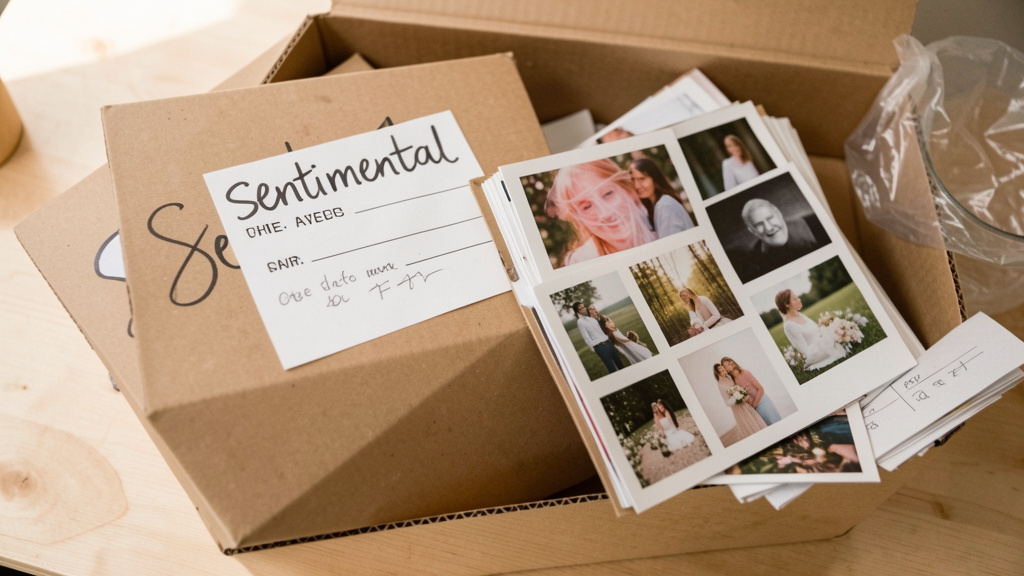
Step 3: Honor Sentimental Items with Intention
Sentimental objects deserve dedicated time—never sort them when tired. Consider these supportive techniques:
– The Photo Archive: For bulky memory items (children’s art projects, trophies), photograph them thoughtfully. Create a digital album titled “Chloe’s Elementary Art.” Keep one representative physical piece. The memory lives digitally; physical space is freed.
– The Memory Container: Limit physical sentimental items to one standardized archival box (e.g., 12x12x6 inches). When full, no more enters. This gentle constraint fosters discernment: “Which drawing best captures her joy that year?”
– Transformation Ideas: Turn a worn baby blanket into pillowcases. Frame a meaningful ticket stub. Repurpose quilt squares into cushion covers. This honors the object’s essence while adapting its form.
– Reflective Writing: For items tied to grief (a spouse’s tools), write a brief note: “Thank you for building our deck. I release you with gratitude.” Seal it. Many find this provides psychological closure.
Never force decisions on high-emotion items. Place them in the “Decision Pause” box. Revisit after sorting neutral zones. Clarity often emerges with time and distance.
Step 4: Navigate Family Dynamics with Clear Communication
Family involvement can enrich or complicate downsizing. Prevent friction with these approaches:
– Schedule dedicated conversations: Invite relatives by appointment to discuss heirlooms. Share photos beforehand: “I’m thoughtfully downsizing Dad’s workshop. Would his vintage wrench set be meaningful to you?” Prevents last-minute pressure.
– Use neutral facilitation if needed: For complex estates, a senior move manager offers objective guidance.
– Document agreements: After gifting an item, send a quick text: “Per our chat, sending you Mom’s pearl necklace. Photo attached for your records.” Creates clarity.
– Respect autonomy: Adult children may not want childhood furniture. Say gently: “No pressure—this is yours if desired. If not, I’ll find it a loving home.” Releases obligation.
Remember: You cannot control others’ reactions. You can control your process. Set time limits for discussions (“We’ll discuss heirlooms for 60 minutes”). Protect your energy.
Step 5: Process Items Promptly—Avoid “Maybe” Purgatory
The “maybe” pile stalls progress. Implement same-day processing where possible:
– Donate items: Load directly into car after sorting. Schedule charity pickup before sorting day.
– Sell items: Photograph and list during sorting. Use local apps like OfferUp to avoid shipping. Set a deadline: Unsold items auto-donate after 14 days.
– Discard items: Place bins in the sorting room. Broken items go straight in.
– Archive items: Seal boxes immediately. Label contents and a future review date (“Open 12/2027”). Store out of sight.
Delayed processing creates visual chaos and decision fatigue. Momentum is your ally. Each cleared space reinforces progress. Celebrate empty shelves—they’re not “bare,” they’re breathing room.
Phase 3: Transition – Cultivating Comfort in Your New Space (Move Week + First 30 Days)
Downsizing success unfolds after boxes are unpacked. This phase ensures your curated belongings integrate smoothly into daily life, supporting well-being and new routines.
Step 1: Guide the Unpacking Sequence
Movers stack boxes efficiently, not intuitively. Prevent post-move overwhelm with clear instructions:
1. Priority 1 (Move Day): Bedding, toiletries, medications, phone chargers, kettle, mug, water, snacks. Label boxes “OPEN FIRST – BEDROOM” prominently.
2. Priority 2 (Next 48 Hours): Kitchen essentials (1 pan, 2 plates, cutlery), bathroom basics, coffee maker.
3. Priority 3 (Week 1): Clothing, daily-use items.
4. Priority 4 (Weeks 2–4): Decor, books, hobby supplies.
Unpacking everything at once creates chaos. Staged unpacking builds familiarity gradually. Place Priority 1 boxes inside the new bedroom/bathroom before movers leave. This small act significantly reduces first-night anxiety.
Step 2: Embrace the “One Week, One Zone” Approach
Resist the urge to “finish” unpacking immediately. Instead:
– Week 1: Bedroom + bathroom only. Establish sleep and hygiene routines.
– Week 2: Kitchen + primary living area. Settle into meal rhythms.
– Week 3: Remaining rooms.
– Week 4: Add decor intentionally.
This prevents burnout. It allows you to live in the space before finalizing layouts. You might discover the planned desk spot has poor light, or the sofa disrupts natural conversation flow. Adaptability beats rigid plans. Leave 20% of storage empty initially—this buffer accommodates discoveries (“I need a spot for library books”) without triggering clutter anxiety.
Step 3: Apply Spatial Awareness Principles
Help your smaller space feel welcoming and functional:
– Vertical Emphasis: Install shelves higher on walls. Use tall, narrow storage units instead of low, wide ones to draw the eye upward.
– Layered Lighting: Combine ambient (ceiling with dimmer), task (desk lamp), and accent (shelf lighting) sources. Avoid relying solely on harsh overhead light. Warm white bulbs (2700K–3000K) generally feel cozier.
– Strategic Mirrors: Place opposite windows to reflect light and views, enhancing perceived depth. Avoid mirrors directly facing beds if it disrupts your rest.
– Color Continuity: Painting walls, trim, and ceilings in a cohesive light neutral (e.g., soft white, warm beige) can reduce visual fragmentation. Add warmth through textiles: a terracotta throw, jute rug, wooden bowl.
– Multi-Functional Furniture Considerations:
– Sofa bed with a supportive mattress for occasional guests
– Ottoman with hidden storage
– Wall-mounted drop-leaf table for flexible dining/work
– Bed frame with under-bed storage solutions
These are intentional choices supporting daily life. A drop-leaf table isn’t a compromise; it’s enabling flexible use of floor space for movement, play, or connection.
Step 4: Cultivate New Rituals with Intention
Downsizing reshapes routines. Proactively design supportive habits:
– The 10-Minute Evening Reset: Before bed, return items to designated homes. Prevents morning clutter buildup.
– The “One In, One Out” Practice: For every new item entering (a gift, purchase), consider releasing one similar item. Maintains equilibrium.
– Monthly Space Check-Ins: First Sunday of each month, walk through with a notepad: “Does this layout still serve us? What feels tight?” Adjust before frustration builds.
– Acknowledge Progress: “We hosted dinner comfortably in our new kitchen!” “I found my keys instantly this morning!” Notice and honor small wins.
Transition isn’t passive adjustment—it’s active co-creation with your space. These rituals transform “living smaller” into “living intentionally.”
Navigating the Emotional Landscape: Honoring Feelings During Transition
Acknowledging complex emotions isn’t weakness—it’s wisdom. Downsizing often coincides with significant life shifts: retirement, loss, children leaving home, health changes. Objects represent chapters. Suppressing emotion often backfires; gently processing it empowers. Here’s how to navigate with self-compassion.
Understanding Emotional Waves in Downsizing
Many experience fluctuating emotions during downsizing (drawing loosely on established grief frameworks):
– Denial: “I’ll keep everything ‘just in case’.” → Gentle response: Revisit your Space Assessment. Reality checks offered kindly.
– Frustration: “Why must I part with the table that held 20 Thanksgivings?” → Response: Honor the memory: “This table held so much love. Its purpose was fulfilled.” Redirect energy toward creating new traditions.
– Bargaining: “If I keep the china cabinet, I’ll donate everything else.” → Response: Apply the Tiered Decision Filter calmly. Does it functionally fit? Does it serve your “Why”?
– Sadness: Tearfulness while sorting baby clothes. → Response: Pause. Step outside. Call your Compassionate Companion. Schedule sorting for your high-energy times.
– Acceptance: “This smaller space supports my goal of traveling more. I choose freedom.” → Response: Reinforce with your “Why” statement. Visualize joyful moments ahead.
These waves aren’t linear. You may feel acceptance Tuesday, sadness Thursday. Normalize this. Keep a small journal nearby: “Today I released Mom’s sewing machine. I felt sad, but also proud—I’m honoring her creativity by making space for my own.” Writing can integrate emotion and cognition.
Special Scenarios: Tailored Compassion
Downsizing After Loss (Widowhood, Divorce)
Spaces hold echoes. Proceed with tenderness:
– Allow time: If possible, delay sorting deeply personal items of a deceased spouse for several months. Grief affects decision-making.
– Seek support: Grief counselors or transition therapists offer valuable guidance.
– Create a memory corner: Dedicate one small shelf for photos, a favorite mug, a meaningful object. Honors the relationship without requiring entire rooms of memorabilia.
– Reframe gently: You aren’t discarding love. You’re transforming how love is held—from physical objects to internalized memory. The love remains; the container evolves.
Downsizing with Adult Children’s Belongings
Clear communication prevents resentment:
– Set kind but firm deadlines: “I’m moving to a smaller home on June 1. Please collect your childhood items by May 15. Unclaimed items will be donated to [Charity Name] on May 20.”
– Offer solutions: “I can store one labeled bin per child in my new garage for a small monthly fee.” Sets boundaries while offering support.
– Photograph items: Send digital albums: “Here are your baseball trophies. I kept the MVP award—rest are ready for pickup.” Reduces “I didn’t know!” conflicts.
– Release guilt: Their belongings are their responsibility. Your peace matters too.
Downsizing Due to Health or Mobility Changes
Focus on capability and independence:
– Prioritize safety: Remove tripping hazards, install grab bars before moving in. Frame this as “designing for continued independence.”
– Consult professionals: Occupational therapists (often covered by insurance) offer home assessments identifying subtle barriers.
– Celebrate gains: “Fewer stairs means more energy for gardening.” “Open floor plan lets me see visitors from the kitchen.” Shift narrative toward liberation.
Emotional friction isn’t a sign you’re “doing it wrong.” It’s proof you’re human. Meet yourself with the kindness you’d offer a dear friend. Schedule rest days. Reward effort with tea, a walk, or calling a supportive person. This journey demands courage—honor yours.
Room-by-Room Downsizing Guidance: Practical Wisdom for Every Zone
Generic advice rarely fits specific spaces. A kitchen requires different logic than a garage. This section offers actionable, zone-specific strategies adaptable to your context. Apply the Intentional Downsizing Framework within each room, using these tailored considerations.
The Kitchen: Balancing Function and Memory
Kitchens accumulate “just in case” items steadily. Apply practicality tempered with awareness of sentimental ties.
Pantry Assessment:
– Empty shelves completely. Wipe clean.
– Check expiration dates first. Discard expired items without guilt.
– Group like items: baking supplies, canned goods, snacks.
– The Usage Check: Haven’t used it in 6–12 months? (Exceptions: holiday-specific items). Be honest about that specialty sauce from years ago. Donate unopened non-perishables to food banks; discard opened items.
– Container Strategy: Transfer staples into uniform airtight containers. Why? Visual calm reduces cooking stress. You see exactly what you have, preventing duplicate buys. Start modestly; expand only if needed.
Cookware & Utensils:
– The Drawer Test: Pull open utensil drawers. If items spill or require digging, you likely have surplus. Keep only what fits neatly.
– Essential Set Template (Adaptable):
– Pots/Pans: 1 small saucepan, 1 medium saucepan, 1 large stockpot, 1 skillet (non-stick), 1 oven-safe skillet (cast iron), 1 baking sheet, 1 casserole dish.
– Utensils: Spatula, slotted spoon, tongs, whisk, ladle, peeler, can opener, 2 knives (chef’s + paring).
– Small Appliances: Keep ONLY what you use regularly. That panini press used once? Consider releasing. Exceptions: Appliances tied to core identity (e.g., bread machine for avid baker).
– Sentimental Kitchen Items: Grandma’s rolling pin? Keep and use it. Display it on a wall hook. If display-only, photograph it and release the physical item. Memory preserved; counter space freed.
Dishes & Glassware:
– Calculate actual need: Number of household members + 2 (for occasional guests). Do you truly need 12 place settings? Most households use 4–6 daily.
– Keep matching sets if you use them for entertaining. If not, mix-and-match is charming and practical.
– Chip Protocol: One chip = consider discarding. Chipped dishes can cut hands and look worn. Donate intact pieces; thrift stores often sell mismatched china as “vintage sets.”
– Specialty Glassware: Wine glasses? Keep what you use. Champagne flutes? Keep a pair if meaningful. Be realistic.
Pro Tip: Before packing kitchen boxes, cook one final meal using only items you plan to keep. This “dry run” reveals hidden essentials (“I forgot I need a garlic press!”) and confirms surplus (“I didn’t miss the waffle maker”).
The Bedroom: Sanctuary Over Storage
Bedrooms should promote rest—not house decades of accumulation. Prioritize calm.
Clothing Sort (The Hanger Method):
1. Turn all hangers backward.
2. After wearing an item, return it with hanger facing forward.
3. After 6–12 months, consider donating items still backward-facing.
Why it works: Provides objective data about usage, reducing guesswork. Works for hanging clothes. For folded items, use vertical folding in drawers to see everything instantly—no buried sweaters.
Under-Bed & Closet Realities:
– Under-bed storage should hold only seasonal items (winter coats in summer) or infrequently used linens. If it’s a dumping ground, reassess your closet system.
– Closet Assessment: Remove everything. Clean shelves. Reassess:
– Does this clothing fit and reflect current style/lifestyle?
– Are shoes in good repair?
– Do you have duplicate basics? (3 black cardigans = keep 1–2)
– Shoe Consideration: If you wouldn’t wear it today with your current wardrobe, consider releasing it. Shoes consume significant space.
Bedding & Linens:
– Keep: 2 sets per bed (1 on bed, 1 in wash), 1 blanket per person, 2–4 decorative pillows max.
– Donate: Stained sheets, mismatched pillowcases, threadbare towels. Animal shelters often accept worn linens for bedding.
– Memory Items: Baby blankets? Photograph. Keep one small swatch sewn into a memory bear (many artisans offer this service).
Nightstand Minimalism:
– Ideal contents: Lamp, book, water glass, phone charger.
– Clear out: Old receipts, dried-up pens, expired medications (dispose safely via pharmacy take-back programs).
– Add: A small tray to corral items. Visual order supports mental calm before sleep.
Critical Insight: Bedrooms often accumulate “temporary” storage (suitcases, gift wrap). Designate one closet shelf for these items in your new home. Contain the chaos; don’t let it colonize your sanctuary.
The Living Area: Curating Connection
This space should facilitate relationship—not showcase accumulation.
Furniture Fit Check:
– Revisit your Space Assessment templates. Does the sofa allow comfortable walking paths (min. 30 inches)?
– Conversation Flow Check: Sit on the sofa. Can you make eye contact with someone in the armchair comfortably? If furniture faces a blank wall, consider rearranging to encourage interaction.
– Release furniture kept “for guests” if guests visit infrequently. A comfortable floor cushion or fold-down wall bed serves occasional needs without dominating daily life.
Media & Books:
– Books: Keep only what you’ll reread or reference meaningfully. Library apps (Libby) offer free digital access to classics. For beloved books, ask: “Does this book live in my heart, or just on my shelf?” Photograph favorite covers for a digital “library.” Donate books to Little Free Libraries or schools.
– DVDs/CDs: Digitize cherished music/movies if desired. Streaming services reduce physical clutter significantly.
– Electronics: Recycle old cords, broken remotes, obsolete chargers promptly. Many retailers (Best Buy, Staples) offer free e-waste recycling. This supports safety and peace of mind.
Decor with Intention:
– Visual Balance (Adapted): Aim for visual harmony—large furniture in neutral tones, secondary colors in textiles, accents in art or pillows. Prevents visual busyness in compact spaces.
– Artwork Strategy: Group small frames into one intentional gallery wall. Avoid scattering single pieces randomly. Larger art = fewer pieces needed.
– Plants as Calm Elements: One healthy, low-light plant (snake plant, ZZ plant) often feels more expansive than many struggling succulents. Choose based on your light and care capacity.
Pro Tip: Before moving furniture, spend time in the empty new space. Sit where the sofa will go. Notice light patterns, noise sources, traffic flow. This lived experience informs layout better than any floor plan alone.
The Home Office / Paper Management: Creating Calm Systems
Paper causes disproportionate anxiety. Systemize it gently.
The Paper Processing Station:
Set up one dedicated spot with:
– Shredder (for sensitive docs)
– Recycling bin
– File box labeled “TO FILE”
– Scanner (phone apps like Adobe Scan work well)
– Three folders: ACTION, WAITING, REFERENCE
Document Triage Approach:
1. Shred Immediately: Junk mail, old utility bills (>1 year old per your record needs), expired coupons.
2. Scan & Discard (if appropriate): Older tax records (consult IRS guidelines), paid medical bills, old insurance policies. Store digital copies securely.
3. File Minimally:
– Active Files: Current tax year, ongoing insurance claims, property deeds.
– Archive Files: Birth certificates, passports, wills. Store in a fire-resistant container.
– Sentimental: Children’s report cards, wedding invitation. Limit to one archival box.
4. Go Digital Thoughtfully:
– Switch bills to paperless where comfortable.
– Use apps like Evernote for handwritten notes (scan and tag).
– Photograph kids’ artwork; create annual photo books.
Office Supplies Reality Check:
– Keep only what fits in one drawer.
– Discard dried-up pens, broken staplers, orphaned clips.
– Donate unopened supplies to schools or shelters.
Critical Reminder: Your expertise and memories reside within you, not solely in paper. Releasing documents isn’t erasing history—it’s trusting your memory and chosen systems.
The Garage / Basement / Attic: Moving Beyond the “Storage Illusion”
These zones often hold deferred decisions. Approach with strategy, not judgment.
The Zone-by-Zone Approach:
– Divide large spaces into manageable sections (e.g., 4×4 ft). Mark with painter’s tape.
– Sort one section per session (max 60–90 minutes). Fatigue leads to poor decisions.
– Categorize as you go: Tools here, holiday decor there, sports gear there.
Category-Specific Considerations:
– Tools: Keep only what you have projects for. No woodworking? Release the saw. Maintain a basic toolkit (hammer, screwdrivers, level, tape measure) for emergencies.
– Holiday Decor: Limit to one standardized container per holiday. When full, no more enters. Photograph elaborate displays for memory; keep only cherished ornaments.
– Sports Equipment: Used in last 1–2 years? Keep. Not used? Donate to schools, community centers, or local sharing groups.
– Building Materials: Partial paint cans? Take to Habitat for Humanity ReStore—they often accept them.
– “Someday” Projects: Be gently honest. That fabric for quilting untouched for years? Consider releasing it. Honor the intention (“I value creativity”) without hoarding the materials.
Safety First:
– Wear gloves and eye protection.
– Check for pests, mold, or structural issues before sorting. Address hazards first.
– Work with a partner in dusty/dark spaces. Safety > speed.
Profound Shift: Reframe these spaces as “decision zones.” Every item represents an unresolved choice. Completing this zone isn’t just about clearing space—it’s about closing mental loops. The relief is often palpable.
Ethical Disposition Guide: Donating, Selling, and Discarding with Care
Releasing items responsibly reduces guilt and amplifies positive impact. Avoid the discomfort of discarding usable goods unnecessarily. This guide supports ethical, efficient disposition—tailored to item type, condition, and your capacity.
The Starting Point: Condition Assessment
Before choosing how to release, assess if it can be released ethically:
– Excellent: Clean, functional, no damage. Ready for reuse.
– Good: Minor wear but fully functional.
– Poor: Broken, stained, missing parts, safety hazard.
– Hazardous: Paint, chemicals, electronics, batteries. Requires special handling.
Important: Avoid donating poor/hazardous items. Thrift stores face significant costs disposing of unusable donations. When in doubt: “Would I give this to a friend in its current state?” If no, discard responsibly.
Disposition Pathways by Category
Clothing & Textiles
| Condition | Thoughtful Path | Why | Helpful Notes |
|---|---|---|---|
| Excellent/Good | Donate to mission-aligned orgs | Maximizes positive impact | – Professional wear: Dress for Success – Winter coats: One Warm Coat drives – Maternity: Local women’s shelters – General: Organizations offering pickup (e.g., Vietnam Veterans of America) |
| Excellent (Designer) | Consignment | Recoups value for quality items | – Research local shops before sorting – Clean/press items – Understand payout terms |
| Worn but intact | Textile recycling | Prevents landfill waste | – H&M, For Days, TerraCycle accept any textiles – Cut usable fabric into rags first |
| Stained/broken | Discard responsibly | No ethical reuse path | – Remove usable buttons/zippers first |
Furniture & Large Items
| Condition | Thoughtful Path | Why | Helpful Notes |
|---|---|---|---|
| Excellent (Stylish) | Sell locally | Finds a loving home; offsets costs | – Photograph in good light – Price reasonably (30–50% of retail) – Use Facebook Marketplace, OfferUp – State “must pick up” |
| Good (Functional) | Donate with pickup | Saves effort; supports community | – Habitat for Humanity ReStore – Furniture Bank networks – Schedule pickup BEFORE sorting day |
| Poor (Broken) | Recycle/Discard | Safety and ethics | – Check municipal bulky waste guidelines – Disassemble if possible |
| Antique/Valuable | Research first | Avoid undervaluing meaningful items | – Consult a certified appraiser if uncertain – Research online marketplaces |
Electronics
| Condition | Thoughtful Path | Why | Helpful Notes |
|---|---|---|---|
| Working | Trade-in or donate | Data security + social impact | – Trade-in: Best Buy, Apple, Gazelle – Donate: PCs for People, InterConnection – WIPE ALL DATA FIRST |
| Broken | E-waste recycling | Prevents environmental harm | – Staples, Best Buy, Call2Recycle.org – Remove batteries |
| Cords/Accessories | Recycle | Rarely reusable; safety hazard | – Many libraries have cord recycling – Cut unusable cords |
Books, Media, Toys
| Condition | Thoughtful Path | Why | Helpful Notes |
|---|---|---|---|
| Books (Good) | Donate strategically | Supports literacy | – Children’s books: Schools, Little Free Libraries – Textbooks: Better World Books – Damaged: Recycle pages; keep covers for crafts |
| Toys (Clean) | Donate to specific needs | Ensures appropriate reuse | – Hospitals: Call child life departments first (strict rules) – Shelters: Confirm current needs – Local sharing groups: Hyper-local gifting |
| Puzzles/Games | Check completeness | Incomplete sets frustrate recipients | – Count pieces before donating – Seal missing pieces in bag taped to box |
Hazardous Materials (Paint, Chemicals, Batteries)
| Item | Disposition | Critical Notes |
|---|---|---|
| Latex Paint | Dry out with kitty litter; discard per local rules | Check municipal guidelines—many have paint exchange |
| Oil-Based Paint | Household Hazardous Waste (HHW) facility | Never pour down drains |
| Batteries | Call2Recycle drop-offs (stores, libraries) | Tape terminals to prevent fire risk |
| Cleaning Chemicals | HHW facility | Do not mix chemicals |
| Medications | Pharmacy take-back or DEA drop boxes | Never flush |
Streamlining the Process: Your Disposition Toolkit
- Schedule pickups FIRST: Book donation pickups before sorting day. Momentum carries items out the door.
- Create a “Sell Station”: Dedicated table with phone, pricing labels. Process items immediately after sorting.
- Batch similar tasks: One afternoon for photographing sell items. Another morning for scheduling pickups.
- Leverage community: Post “free to good home” in local sharing groups for bulky items. Specify “must pick up today.”
- Tax documentation: Save donation receipts. Use apps like ItsDeductible to track values. Consult a tax professional for significant donations.
Ethical disposition transforms release from loss into legacy. That donated sofa comforts a family rebuilding after hardship. Those children’s books ignite curiosity. Your conscious choices ripple outward. Honor the journey of each item—then release it with gratitude.
Cultivating Joy in Compact Spaces: Beyond Storage to Intentional Living
Thriving in a smaller home stems not from clever hacks, but from human-centered design. Focus on curating experiences, not cramming possessions. This section moves beyond surface tips to principles that foster well-being, connection, and daily delight in reduced square footage.
The Perception of Space: Why Feeling Matters
Neuroscience and design research offer insights into why some small spaces feel expansive:
– Visual Weight: Light-colored, leggy furniture (sofas on slender legs, glass-top tables) allows light to flow underneath, creating perceived openness. Dark, bulky pieces can visually anchor a room.
– Sightlines: Unobstructed views from entryway through living area signal spaciousness. Avoid placing tall furniture perpendicular to main pathways.
– Nature Connection: Incorporating even one thriving plant can support calm. Prioritize one real plant over decorative clutter.
– Curated Personalization: Too many personal items create visual noise. Select 3–5 meaningful objects per room (a family photo, a travel souvenir, a piece of art). Rotate seasonally to keep spaces feeling fresh without accumulation.
Action Step: Stand at your new home’s entrance. What’s the first thing you see? If it’s a wall of closed doors or stacked boxes, consider rearranging. Create a “visual journey”—a path for the eye to travel comfortably. This simple shift alters perception.
Flexible Zones: Designing for Fluid Living
Rigid room definitions (“this is ONLY a dining room”) can waste precious square footage. Embrace fluidity:
– The Dining Table Pivot:
– Day: Workspace for bills, crafts.
– Evening: Family meals.
– Weekend: Game night hub.
Key: Use a table with leaves or a drop-leaf design. Store chairs compactly when not in use.
– Living Room Adaptability:
– Choose a sofa bed with a supportive mattress if guests visit occasionally.
– Use nesting tables: Pull out one for coffee, two for snacks.
– Install wall-mounted TV with slim console—avoid bulky entertainment centers.
– Bedroom as Retreat:
– Avoid desks or exercise equipment in bedrooms if possible. Protect sleep sanctuary.
– If space demands multi-use, use a room divider (folding screen, curtain) to visually separate zones during rest hours.
Critical Insight: Define zones by activity, not walls. A rug + armchair = reading nook. A small cart with tea supplies = beverage station. These micro-zones create psychological separation without physical barriers.
Lighting: Shaping Atmosphere and Perception
Lighting profoundly influences how a space feels. Layer intentionally:
1. Ambient Light (Foundation):
– Recessed ceiling lights or a central fixture with dimmer switch.
– Avoid: Single harsh overhead light—it creates shadows and feels institutional.
2. Task Lighting (Function):
– Adjustable desk lamp for workspace.
– Under-cabinet LED strips in kitchen (enhances counter visibility).
– Swing-arm wall sconces beside bed (frees nightstand space).
3. Accent Lighting (Warmth):
– Small LED puck lights inside glass-front cabinets.
– String lights draped artfully (use warm white).
– Flameless candle on dining table for ambiance.
Pro Tip: Install dimmer switches where possible. Lower light levels in evenings signal relaxation. Bright light for tasks; soft light for unwinding. Control supports comfort.
Color, Texture, and Light: Creating Depth
- Wall Strategy: Painting walls, trim, and ceilings in a cohesive light neutral can reduce visual “edges,” making rooms feel more unified. Add warmth with textiles: a terracotta throw pillow, a jute rug, a wooden bowl.
- Strategic Accent: If using a deeper color, place it on the wall opposite the main window. Darker hues can recede visually, enhancing depth. Avoid accent walls on short walls—they may compress space.
- Texture Over Pattern: In small doses, texture adds richness without visual chaos. A nubby wool blanket, a smooth ceramic vase, a woven seagrass basket. Limit bold patterns to one focal item per room.
- Mirror Placement: Position a mirror across from a window. Reflects light and outdoor views, enhancing perceived space. Avoid fragmented mirror arrangements—they can create visual confusion.
Note for Climate Context: In regions with limited winter light, maximize reflective surfaces and warm lighting. In sun-drenched climates, consider light-filtering window treatments to manage glare while preserving views.
Integrating Outdoor Space: Expanding Your Living Area
Even a small balcony or patio multiplies usable space:
– Vertical Gardens: Install wall planters for herbs or flowers. Adds life without floor clutter.
– Fold-Down Table: Mounts to railing; flips up when not in use. Perfect for morning coffee.
– Weather-Resistant Storage: Bench with hidden compartment stores cushions, tools, games.
– Lighting Extension: String lights or solar path lights extend usability into evenings.
– Define the Zone: An outdoor rug + two chairs = intentional space. Not “leftover area.”
Psychological Note: Access to nature—even a potted plant on a fire escape—can support stress reduction and focus. Prioritize this connection where possible.
Embracing Negative Space: The Power of Pause
In art, negative space (the area around subjects) defines the composition. In homes, empty space defines comfort. Resist the urge to fill every inch:
– Leave breathing room: Aim for 20% of surfaces clear (countertops, shelves, floors). This isn’t “wasted” space—it’s visual rest.
– Maintain pathways: Keep 30–36 inches of clear floor space between furniture. Prevents claustrophobia and supports safe movement.
– Edit gently: If adding a new decor item, consider removing one existing item. Maintain equilibrium.
Wisdom from Design Traditions: Ma (間) is the Japanese concept of intentional void. It’s not emptiness—it’s potential. The space between chairs invites conversation. The clear countertop invites meal prep. Honor the void. It is where life happens.
Designing a smaller home isn’t about deprivation. It’s about distillation—refining your environment to its most meaningful essence. Every choice becomes intentional. Every object earns its place. This curated space doesn’t just house your life; it actively supports your well-being, relationships, and daily rituals. That is the true gift of living intentionally.
Navigating Common Downsizing Challenges: Practical Solutions
Even with thoughtful planning, challenges arise. Anticipating these pain points prevents derailment. Below are frequent friction points observed in downsizing journeys—with precise, actionable solutions. Bookmark this section for tough days.
Challenge 1: Decision Paralysis Over a Single Item
The Trap: Fixating on one object (a vase, a tool) halts all progress. Energy drains into circular thinking.
Why It Happens: The item often represents a larger unresolved feeling (“Am I honoring my past?”). The brain fixates on the tangible to avoid the intangible.
Solution Protocol:
1. Pause Immediately: Say aloud: “This decision needs space. I’m placing it in the Decision Pause box.” Naming the pattern reduces its power.
2. Apply the 72-Hour Rule: Seal the item in a labeled box. Store out of sight. Do not revisit for 72 hours.
3. Revisit Calmly: After 72 hours, apply the Tiered Decision Filter (Function → Frequency → Value → Legacy).
4. Choose Forward Motion: If still uncertain:
– Sentimental item? Photograph it. Release the physical object.
– Practical item? Note where to replace it affordably if needed later.
– Legacy item? Text the intended person: “Thinking of you—would this be meaningful?”
Prevention Tip: Limit the Decision Pause box to one standard shoebox size. When full, process all items inside before adding more.
Challenge 2: Family Dynamics Around Shared Items
The Trap: Disagreements over heirlooms, childhood furniture, or shared possessions. Emotions escalate; progress stalls.
Why It Happens: Objects symbolize love, memory, or perceived fairness. Unspoken expectations collide with practical constraints.
Solution Protocol:
1. Separate People from Problems: Frame discussion around shared values: “We all want Mom’s memory honored. How can we do that within the space of my new home?”
2. Use Objective Criteria:
– For furniture: “Does it fit the new space? Is it in good repair? Who will maintain it?”
– For sentimental items: “Who has the strongest connection and space to display it?”
3. Implement Fair Processes:
– Taking turns: “You choose first this time; I choose first next time.”
– Neutral facilitation: For complex estates, a senior move manager offers objectivity.
4. Document Agreements: Text a summary: “Per our call, Sarah takes the rocking chair, Mark takes the quilt. I’ll arrange shipping by Friday.” Prevents future confusion.
Prevention Tip: Initiate heirloom conversations early—weeks before sorting. Send photos: “I’m thoughtfully downsizing. Would these items be meaningful to you?” Gives people time to process.
Challenge 3: Physical or Emotional Fatigue
The Trap: Pushing through exhaustion leads to regretted decisions, tears, or abandoning the project.
Why It Happens: Downsizing is cognitively and emotionally demanding. Decision fatigue is real.
Solution Protocol:
1. Honor Your Limits: Set a timer for 45 minutes of sorting. When it rings, stop. Walk outside. Drink water. This isn’t quitting—it’s strategic pacing.
2. Schedule Energy, Not Just Time: Sort during your natural energy peaks. Never sort when hungry, angry, lonely, or tired (HALT principle).
3. Delegate Thoughtfully:
– Hire help for heavy lifting if possible.
– Task your Logistics Helper with scheduling pickups.
– Ask your Compassionate Companion to handle donation drop-offs.
4. Reset Ritual: When overwhelmed, pause. Breathe deeply 5 times. Say: “This is hard because it matters. I am doing enough.” Then choose one tiny action: “I’ll clear this one drawer.” Momentum rebuilds from micro-wins.
Prevention Tip: Block “recovery days” on your calendar—no sorting allowed. Rest is part of the process.
Challenge 4: Unexpected Logistical Hurdles
The Trap: Discovering movers charge extra for stairs, donation centers reject items, or new space has unexpected constraints.
Why It Happens: Incomplete preparation or unforeseen variables.
Solution Protocol:
1. Contingency Buffer: Allocate 10–15% of moving budget for surprises (extra supplies, disposal fees).
2. Pre-Move Verification Checklist:
– [ ] Confirm mover’s policy on stairs, long carries, parking
– [ ] Call donation centers: “Do you accept [item type] in [condition]?”
– [ ] Measure new home’s doorways, stairwells, elevator dimensions
– [ ] Test assemble large furniture in new space before moving day
3. Problem-Solving Script: When surprise hits, ask:
– “What’s the smallest step to resolve this?”
– “Who can help?” (Logistics Helper? Mover?)
– “What’s the acceptable ‘good enough’ solution?”
Prevention Tip: Do a “dry run”: Pack one box, carry it to your car, drive to new home, carry it inside. Reveals hidden hurdles.
Challenge 5: Post-Move Adjustment Period
The Trap: After boxes are unpacked, sadness or uncertainty arises: “I miss my old kitchen,” “The house feels too quiet.”
Why It Happens: Transition grief is normal. The brain mourns familiar routines and spatial memories.
Solution Protocol:
1. Normalize the Feeling: Say: “This is adjustment. It doesn’t mean I made a wrong choice. It means I cared deeply about my old home.”
2. Create New Rituals Immediately:
– Brew coffee in the new kitchen while watching sunrise.
– Host a small “welcome” gathering with close friends.
– Plant one flower in the new garden/balcony.
3. Focus on Gains: Journal prompts:
– “What’s easier today than in my old home?” (Less cleaning? Closer to park?)
– “What new opportunity does this space create?”
4. Allow Time: Adjustment typically takes several months. Be patient. Decorate slowly. Let the space reveal its personality.
Prevention Tip: Before moving day, take candid photos of your old home as it was lived in. Review them if sadness arises; then gently close the album and engage with your new reality.
Challenges aren’t failure—they’re data. Each reveals where your process needs refinement. Meet challenges with curiosity, not criticism. You’ve navigated harder things. This is another step toward a home that truly fits your life.
Your Questions, Answered: Real Downsizing Concerns Addressed
Drawing from common inquiries and observed patterns, here are thoughtful responses to pressing downsizing questions.
Q: How do I decide what to keep when space is extremely limited (under 800 sq ft)?
A: Start with “Non-Negotiables.” List essentials for daily functioning and core identity:
– Physical needs: Bed, accessible shower, food prep space, seating for household members.
– Identity anchors: Items central to who you are (e.g., musician = instrument; gardener = favorite trowel).
– Relationship supports: Space for meaningful connection (e.g., two comfortable chairs).
Evaluate everything else against these pillars. Does the item serve a non-negotiable? If not, its priority lowers. This isn’t deprivation—it’s strategic allocation of precious space. Remember: Libraries, tool libraries, and community resources provide access without ownership.
Q: What should I do with family heirlooms no one wants but I feel guilty discarding?
A: Guilt is a signal—not a command. First, verify no one wants it: Send clear photos with a gentle deadline (“Please let me know by June 1 if this would be meaningful to you”). If unclaimed:
– Photograph beautifully: Create a digital album titled “Family Legacy.” Share with relatives. The memory is preserved.
– Repurpose thoughtfully: Turn quilt squares into pillow covers; use china shards in mosaic art.
– Donate strategically: Local historical societies may want items with community significance (call first).
– Release with ritual: Write a brief note of gratitude to the ancestor. “Thank you for this vase. Its beauty brought joy. I release it now to bring joy elsewhere.” This honors the object’s journey without burdening your space. Guilt often softens when action aligns with respect.
Q: How can I make a small kitchen feel functional without constant clutter?
A: Focus on workflow and daily reset habits:
– Workflow: Position sink, stove, and refrigerator to minimize steps.
– Vertical Storage: Install rails with hooks for pots, pans, utensils. Frees drawer space.
– Drawer Dividers: Use adjustable dividers in every drawer. Prevents “junk drawer” syndrome.
– Appliance Garage: A small cabinet section (or decorative box) hides toaster, blender when not in use. Visual calm supports mental calm.
– Daily Reset: Spend 5 minutes each evening wiping counters, loading dishwasher, returning items. Prevents morning chaos.
Remember: A small kitchen used intentionally feels more spacious than a large kitchen in disarray. Function follows thoughtful form.
Q: Is it worth hiring professional organizers or senior move managers? How do I choose?
A: Yes—if budget allows and emotional complexity is high (grief, family dynamics, mobility considerations). Professionals provide neutrality, efficiency, and emotional buffering. To choose wisely:
– Verify credentials: Look for NAPO (National Association of Productivity and Organizing Professionals) or NASMM (National Association of Senior Move Managers) membership.
– Ask targeted questions: “How do you handle sentimental items?” “What’s your process for involving family?” “Can you provide references?”
– Clarify scope: Get written estimates detailing services (sorting? packing? donation coordination?) and rates.
– Trust your gut: Choose someone whose communication style feels calm and respectful.
For moderate budgets, hire help for one challenging zone (attic, garage) to build momentum. Their expertise often supports smoother progress.
Q: How do I handle downsizing when my partner disagrees on what to keep?
A: Conflict often stems from unspoken fears (“Will I lose my identity?”). Navigate with these steps:
1. Separate sessions: Sort personal items alone first (clothes, books, hobby gear). Reduces immediate friction.
2. Joint decisions framework: For shared spaces, use the Tiered Decision Filter together. “Does this sofa fit? Do we use it weekly? Does it support our goal of cozy movie nights?”
3. Trade concessions: “I’ll keep your record collection if we release the extra bookshelf.” Find mutual wins.
4. Neutral facilitator: If stuck, involve a counselor or move manager. Their objectivity breaks deadlocks.
Listen to the emotion beneath the objection (“I’m scared of losing memories” vs. “We must keep this cabinet”). Address the feeling, not just the object.
Q: What’s the most common pitfall to avoid when downsizing?
A: Rushing preparation. Skipping the Space Assessment leads to “Will it fit?” anxiety. Avoiding the “Why” definition causes regretted decisions (“I kept this because it was expensive, not because I love it”). Not securing support systems results in burnout. Preparation isn’t optional—it’s the foundation. Invest time in planning. It supports smoother progress later. As the proverb reminds us: “Measure twice, cut once.” In downsizing: “Prepare thoroughly, sort intentionally.”
Q: How do I downsize digital clutter alongside physical items?
A: Digital chaos amplifies physical stress. Tackle it concurrently:
– Photos: Back up to cloud storage. Delete blurry/duplicate shots. Create annual highlight albums.
– Files: Unsubscribe from retail emails. Organize documents into cloud folders (Finance, Medical, Home). Delete old downloads.
– Devices: Wipe old phones/tablets before recycling. Use manufacturer trade-in programs.
– Password manager: Install a reputable password manager. Reduces digital anxiety significantly.
Schedule one 30-minute “digital declutter” session per week during your physical downsizing. The mental clarity compounds.
Q: What if I downsize and then regret releasing something?
A: Regret is normal—but rarely catastrophic. First, breathe. Then:
– Assess impact: Is this a true need (“I need a screwdriver”) or emotional longing (“I miss that vase”)?
– Solve practically: Buy a basic replacement ($5 screwdriver at hardware store). For sentimental items, remember: The memory exists independently of the object.
– Learn gently: Note why regret occurred. “I kept kitchen gadgets but released tools—I use tools more.” Adjust future decisions.
– Practice self-compassion: You made the best choice with information available. Growth includes gentle course-correction. Most “regrets” fade within weeks as new routines form. Trust your resilience.
Q: How do I involve children (of any age) in downsizing without causing anxiety?
A: Frame it positively: “We’re making space for new adventures!” Tailor involvement:
– Young children: Let them choose which 5 stuffed animals travel to the new home. Pack a “first night” box with their favorites.
– Teens: Give autonomy over their rooms. Provide criteria (“Must fit in this closet”), then step back. Respect their choices.
– Adult children: Communicate early about childhood items. Offer first refusal with clear deadlines.
– All ages: Create a memory book together—photos of old home, drawings of new room. Validates feelings while building excitement.
Never force decisions. Their sense of security matters more than perfect minimalism.
Q: Are there items I should absolutely NOT donate?
A: Yes. Ethical donation protects charities and your community:
– Recalled items: Check cpsc.gov for recalls (especially cribs, car seats, toys).
– Stained/damaged textiles: Thrift stores cannot sell these; they burden waste streams.
– Expired medications: Take to pharmacy take-back programs. Never donate.
– Hazardous materials: Paint, chemicals, batteries—require special disposal.
– Incomplete sets: Puzzles missing pieces frustrate recipients.
When in doubt: “Would I give this to a friend in its current state?” If no, discard responsibly. True generosity means giving items that uplift—not burden—others.
Q: How long does the emotional adjustment to a smaller space typically take?
A: Adjustment timelines vary widely—often several months. Factors influencing the pace include:
– Preparation: Those who clarified their “Why” often adjust more smoothly.
– Social support: Strong connections ease transition.
– New space quality: Well-designed small spaces feel comfortable quicker.
– Life context: Downsizing amid other stressors may extend adjustment.
Be patient with yourself. Track small wins: “I found my keys instantly today,” “I love my morning coffee nook.” Adjustment isn’t linear—some days feel great; others feel hard. Honor all feelings. You’re not just moving houses; you’re integrating a new chapter of life. That takes time, and that’s okay.
Conclusion and Your Next Step: From Strategy to Serene Living
You now hold a compassionate compass for your downsizing journey—not just a task list, but a framework honoring both practical logistics and human emotion. This path transforms what is often framed as loss into profound gain: the gain of clarity over clutter, intention over inertia, and space—physical and mental—for what truly matters to you. Recall the three pillars that support this approach:
1. Preparation is self-care: The Space Assessment, clarified “Why,” and support circle aren’t bureaucratic steps. They are acts of respect for your future peace.
2. Compassionate curation supports sustainability: The Tiered Decision Filter and Memory Container techniques honor your history while designing your future. You release guilt; you keep meaning.
3. Transition is co-creation: Unpacking intentionally, designing flexible zones, and establishing new rituals turn a smaller space into a sanctuary actively supporting your well-being.
This journey asks courage. It requires sitting with discomfort, making conscious choices, and trusting that less can be more—not as a slogan, but as a lived experience of lighter mornings, clearer countertops, and evenings spent connecting rather than cleaning. Those who walk this path often discover unexpected gifts: deeper conversations in cozy living rooms, rediscovered hobbies in repurposed spaces, and the quiet pride of a home that reflects their current values, not past obligations. Downsizing also connects to broader well-being—reduced environmental footprint through mindful consumption, greater financial flexibility, and mental space reclaimed from maintaining excess.
The 24-Hour Invitation: Your Tiny, Transformative Action
Within the next 24 hours, take one small, concrete step. Not “start sorting,” but this:
Choose one drawer, shelf, or cabinet. Set a timer for 20 minutes. Apply the Tiered Decision Filter to every item inside. Process decisions immediately (donate bag by the door, trash bin nearby). When timer ends, stop. Notice the cleared space.
This micro-action builds momentum without overwhelm. It proves you can do this—one intentional choice at a time. The entire journey begins here.
The Bigger Picture: Your Home as a Living Reflection
Your space is not a static container. It is a dynamic partner in your life story—a canvas for daily rituals, a shelter for rest, a stage for connection. Downsizing is not an endpoint; it is a conscious recalibration. It asks: What life do I want to live here? Every released item makes room for that answer. Every curated object becomes a deliberate note in the symphony of your days.
You are not shrinking your life. You are refining it. You are making space for morning light on a clear countertop, for grandchildren’s laughter in an uncluttered living room, for the deep breath of walking into a home that feels yours—calm, capable, and intentionally designed for the chapter you are living now.
This is more than moving smaller. This is living with greater intention—in heart, in purpose, in peace. Your journey begins with one drawer. We honor the courage it takes to start.
Explore Our Complete System:
The Mindful Decluttering Guide: Before You Pack a Box | Small Space Living: Functional Design Principles for Comfort | Navigating Emotional Transitions: A Compassionate Guide to Letting Go | Moving Mindfully: A Stress-Reduced Relocation Checklist | Legacy Without Load: Preserving Memories Lightly | The First 30 Days: Building Joyful Routines in Your New Home | Conscious Consumption: Sustainable Choices for Home and Life