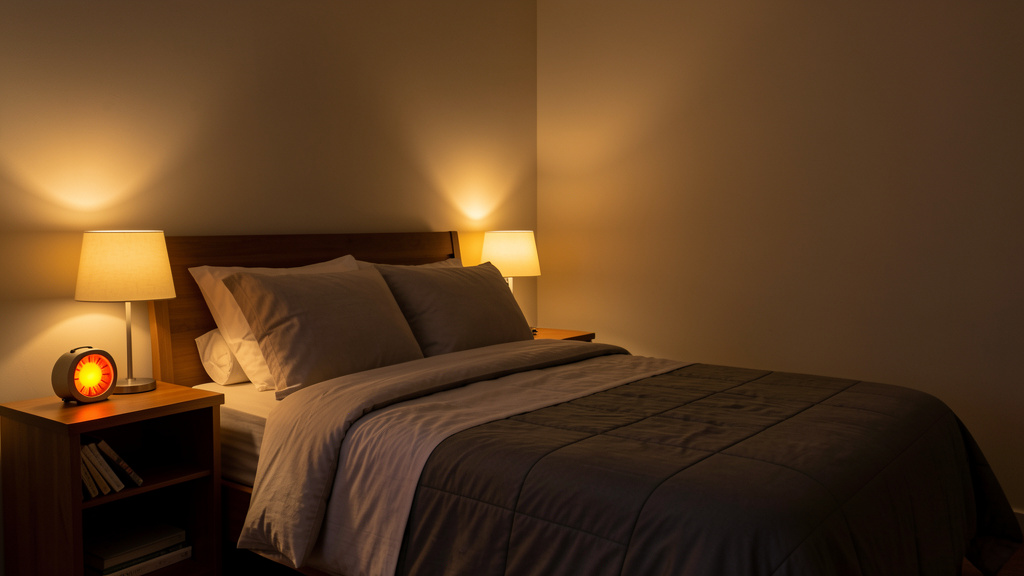
Create a restorative bedroom lighting environment that honors your body’s innate biological rhythms—thoughtfully designed for real life, adaptable to your space, and grounded in accessible science.
Your bedroom lighting communicates silently with specialized cells in your eyes, sending timing signals that influence sleep quality, daytime alertness, mood regulation, and overall physiological balance. Modern lifestyles often place us under artificial light that contradicts natural daylight patterns: cool-toned screens deep into evening, insufficient bright light during daytime hours, and inconsistent lighting routines. This guide synthesizes established chronobiology principles with practical, adaptable strategies to help you shape a bedroom lighting environment that works with your biology—not against it. Whether you rent or own, live in a sunlit room or an interior space, these evidence-informed approaches offer flexible pathways to greater circadian alignment without demanding perfection.
Introduction: Light as a Biological Signal
Each morning, specialized photoreceptors in your retina—distinct from those used for vision—detect the intensity, color, and timing of ambient light. These intrinsically photosensitive retinal ganglion cells (ipRGCs) relay signals to your brain’s suprachiasmatic nucleus (SCN), a cluster of neurons acting as your body’s master circadian pacemaker. This system helps regulate the timing of cortisol release for morning alertness, melatonin secretion for nighttime restoration, core body temperature shifts, and other physiological processes. When artificial light exposure conflicts with natural patterns—such as bright blue-rich light late at night or insufficient daylight during waking hours—this internal rhythm may become less stable.
Research from institutions like the Lighting Research Center at Rensselaer Polytechnic Institute and the National Institutes of Health indicates that consistent, well-timed light exposure supports healthier sleep-wake cycles. Studies associate chronic circadian disruption with increased risks for sleep difficulties, mood fluctuations, and metabolic changes. Importantly, the American Medical Association has noted concerns about artificial light at night, while the World Health Organization classifies shift work involving circadian disruption as a probable carcinogen. These findings underscore light’s biological significance—not to induce anxiety, but to highlight an accessible lever for daily wellness.
Unlike genetic or systemic health factors, your light environment is highly modifiable. You don’t need specialized equipment or major renovations to begin. This guide moves beyond oversimplified tips like “use warm bulbs” to offer a flexible, phase-based framework addressing spectral quality, intensity awareness, timing consistency, spatial considerations, and real-world constraints. Every suggestion includes adaptable options—because sustainable change fits your life.
The Circadian Harmony Framework: Three Phases for Daily Alignment
True circadian support requires a dynamic approach that mirrors nature’s rhythm—not a single “perfect” setting. Grounded in research on melanopic equivalent daylight illuminance (mel-EDI), the Circadian Harmony Framework organizes bedroom lighting into three intentional phases. Each phase aligns with your body’s changing needs across the 24-hour cycle, emphasizing transitions over static conditions. Flexibility is built in: adapt timing to your schedule, season, and living context.
Phase 1: Gentle Morning Activation (Approx. Wake Time to 9:00 AM)
Purpose: Support natural cortisol awakening, gently suppress residual melatonin, and reinforce your body’s “daytime has begun” signal.
Why Timing Matters: Your internal clock runs slightly longer than 24 hours. Without consistent morning light cues—called zeitgebers (German for “time-givers”)—your rhythm may gradually drift later. Research suggests that regular morning light exposure helps stabilize sleep timing and supports next-day alertness. Light exposure after your body’s natural temperature minimum (typically 2–3 hours before habitual wake time) tends to advance your clock, aiding earlier rising.
Adaptable Implementation:
– Prioritize Natural Light: If possible, open curtains before bed (using retractable blackout liners if needed). Upon waking, spend 10–20 minutes near a window with a view of the sky. Even on cloudy days, outdoor light (1,000–10,000 lux) significantly exceeds typical indoor levels (100–500 lux).
– Artificial Dawn Simulation (When Needed): Place a dawn simulator lamp 1–2 feet from your pillow, angled toward closed eyelids (light penetrates eyelids at reduced intensity). Begin 30–45 minutes before target wake time at very low brightness, gradually increasing to soft white (≈3,000K). Avoid abrupt brightness jumps.
– Smart Bulb Option: Program bedside lamps to shift from deep amber (≈2,200K) at minimal brightness to soft white (≈3,000K) over 30–45 minutes. Position lamps to cast gentle, directional light—not harsh overhead illumination.
– Intensity Awareness: Aim for moderate brightness upon waking. If using artificial light, combine sources (e.g., lamp + window) for balanced illumination. Avoid staring directly at bright bulbs.
Common Considerations:
– Phone Use Upon Waking: Screens emit concentrated blue light close to the eyes. While morning blue light can be beneficial, uncontrolled exposure combined with content stress may create unintended arousal. Consider keeping phones out of reach overnight and using a dedicated lamp as your alarm cue. If device use is necessary, enable grayscale mode and minimize brightness for the first 15–20 minutes awake.
– Overhead Lighting: Harsh ceiling lights lack the directional quality of sunrise and may feel clinical. Layer light sources: use wall sconces aimed upward, a dimmable bedside lamp, or window light for a gentler transition.
– Weekend Consistency: Significant shifts in wake time between weekdays and weekends may contribute to “social jet lag.” When possible, maintain wake times within a 60-minute window daily. Program dawn simulators for consistent activation—even on weekends—to support rhythm stability.
Phase 2: Daytime Reinforcement (Approx. 9:00 AM to 5:00 PM)
Purpose: Strengthen circadian alignment during waking hours, support sustained alertness, and build natural sleep pressure for restorative nighttime recovery.
Why This Phase Matters (Even Outside the Bedroom): If you spend daytime hours in your bedroom (working, resting, exercising), light exposure here directly influences your rhythm. More broadly, insufficient bright, blue-enriched light during daytime hours weakens your entire circadian signal, potentially making evening wind-down less effective. Studies note that access to daylight correlates with longer, higher-quality sleep—principles applicable to residential environments.
Adaptable Implementation:
– Maximize Daylight: Keep window coverings open during daylight hours. Position seating or work areas within 6–8 feet of windows. Clean windows seasonally; dirt can reduce light transmission noticeably. For north-facing windows (Northern Hemisphere), use light-colored walls opposite the window to reflect illumination deeper into the room.
– Supplemental Lighting (If Needed): In low-light rooms, add task lighting with bulbs in the 4,000K–5,000K range during daytime hours. Aim for comfortable brightness at seating areas (≈300–500 lux). Use dimmers to adjust for changing daylight. Prioritize indirect lighting—bounce light off walls or ceilings to reduce glare.
– Reflective Surfaces: A full-length mirror opposite a window can redirect daylight deeper into the room. Choose frames with light-reflective finishes. Light-colored walls, floors, and furnishings also amplify available light.
– Seasonal Awareness: In winter months with shorter days, extend supplemental lighting duration. If experiencing low energy or seasonal mood shifts, consider brief use of a light therapy lamp (10,000 lux) within 60 minutes of waking—positioned to the side of your visual field, not stared at directly. Consult a healthcare provider for personalized guidance.
Common Considerations:
– Consistently Dim or Warm Lighting All Day: Very low-intensity or exclusively warm-toned light throughout daytime hours may send ambiguous signals to your circadian system. When feasible, allow brighter, cooler-toned light during active daytime hours. Smart bulbs can automate transitions (e.g., 5,000K at higher brightness from 9 AM–3 PM, shifting warmer later).
– Glare and Discomfort: Harsh direct light causes visual strain. Choose fixtures with diffusers (frosted glass, fabric shades). Position task lights to illuminate surfaces, not shine directly into eyes. Uplighting floor lamps or wall sconces create softer ambient glow.
– Surface Colors: Dark walls absorb significant light, requiring brighter fixtures to achieve similar illumination. For bedrooms used during daytime, lighter wall colors (soft whites, warm beiges with high Light Reflectance Value) enhance brightness efficiently. Use deeper tones sparingly as accents.
Phase 3: Evening Wind-Down (Approx. Sunset to Bedtime)
Purpose: Gradually reduce biologically active light exposure, support natural melatonin onset, lower core body temperature, and signal the nervous system to prepare for rest.
Why Gradual Transition Matters: Melatonin release follows a curve influenced by light exposure over the preceding 1–2 hours. Research indicates that light above certain intensity thresholds—particularly in the blue-green spectrum—after sunset may delay melatonin onset and affect sleep architecture. The goal isn’t total darkness at dusk (often impractical), but a controlled, progressive reduction in light intensity and spectral stimulation that mirrors natural twilight.
Adaptable Implementation (The 2–3 Hour Wind-Down):
– Early Evening (Start at Sunset or ~6:00 PM): Shift artificial lighting to ≤2,700K. Dim overhead lights to 40–50% if used. Maximize residual natural light.
– Mid Evening (~7:00–8:30 PM): Transition to localized, warm task lighting (≤2,200K). Turn off overhead fixtures. Use salt lamps, candle-style LED bulbs (flicker mode optional), or low-wattage bulbs in shaded bedside lamps. Target comfortable but subdued brightness (<50 lux at eye level).
– Pre-Sleep Hour (~8:30 PM to Bedtime): Further reduce to ≤1,800K (amber/red spectrum). Use only minimal path lighting if needed for safety (e.g., motion-sensor nightlights under the bed frame). Eliminate screens. For essential tasks, use a dimmable amber lamp positioned below eye level.
– Automation Support: Program smart scenes: “Evening Wind Down” (shift to 2,200K at reduced brightness), “Bedtime Prep” (shift to 1,800K in bedside lamps only). Integrate motion sensors for bathroom trips—set to very dim amber light.
– Fixture Placement: Position bedside lamps to shine downward onto books/tasks, not upward toward eyes. Use lampshades with opaque liners to prevent direct bulb visibility.
A Foundational Insight: Circadian lighting isn’t about eliminating light after dark—it’s about intentionally shifting light’s qualities to align with your body’s evolved expectations. Even brief exposure to bright, blue-rich light late in the evening can influence your internal timing; honoring this sensitivity with small, consistent adjustments fosters greater rhythm stability.
Common Considerations:
– Device “Night Mode” Alone: While night mode reduces some blue light, screens remain bright point sources held close to the eyes. A tablet in night mode at moderate brightness may still emit light levels associated with melatonin suppression in research settings. Consider a digital sunset 60–90 minutes before bed: charge devices outside the bedroom. Replace screen time with low-light activities like reading physical books under warm lamplight, gentle stretching, or quiet conversation. If essential device use occurs, enable night mode and reduce brightness significantly, hold the device farther away, and consider amber-lens glasses.
– Bright Bathroom/Closet Lighting: A brief exposure to cool-white overhead lights while preparing for bed may deliver a potent circadian signal. Retrofit closet and bathroom fixtures with dimmable warm bulbs (≤2,200K). Install motion-sensor nightlights (1,800K) for nighttime trips. Use a small, warm mirror light for evening grooming instead of bright overheads.
– Candlelight Nuance: While candlelight (≈1,850K) has favorable spectral properties, multiple candles clustered near the bed can create higher-than-expected brightness. Flickering light may also be stimulating for some. Use candles sparingly for ambiance, placed away from direct line of sight. High-quality LED “flame effect” bulbs in amber tones at very low brightness offer a consistent, safe alternative for the final wind-down hour.
Integrating Fixtures, Layout, and Natural Light Thoughtfully
Bulb selection is only one piece. Thoughtful integration of fixtures, spatial layout, window treatments, and surface choices creates a cohesive light environment that supports both function and biology.
Layering Light for Flexibility and Comfort
Effective bedroom lighting combines three layers, adjustable across circadian phases:
-
Ambient Layer (Overall Illumination): Provides foundational, shadow-minimizing light. Prioritize dimmable, spectrally adaptable sources. Avoid relying solely on a single central ceiling fixture. Consider:
- Recessed LED downlights on a dimmer (use 2,700K–3,000K bulbs; avoid cool white).
- Cove lighting (LED strips hidden in a ceiling ledge) aimed upward to bounce soft light off the ceiling—reducing glare and mimicking skylight.
- Central fixtures with fabric or paper shades that diffuse light both downward and upward.
-
Task Layer (Focused Illumination): Delivers light precisely where needed without flooding the room—critical for evening wind-down:
- Bedside Lighting: Swing-arm wall sconces positioned 42–48 inches above the mattress allow adjustable aiming for reading. This keeps light localized, avoids glare, and frees nightstand space. Use dimmable warm bulbs. If using table lamps, choose styles with opaque shades that direct light downward and prevent bulb visibility.
- Seating Area: Floor lamps with adjustable heads position light onto books or tasks, not across the room.
- Closets: Motion-activated LED strips with warm bulbs (≤2,200K) provide gentle task light without disrupting wind-down.
-
Accent Layer (Subtle Enhancement): Highlights features while supporting spatial comfort:
- Low-voltage LED tape under floating nightstands or bed frames (set to 1,800K after 8 PM) offers safe nighttime navigation.
- Narrow-beam lights grazing textured walls enhance visual interest during daytime; turn off entirely during evening wind-down.
- A small, dimmable uplight behind the headboard creates a soft halo effect, reducing contrast between dark room and task lights.
Window Treatment Strategy: Working With Natural Light
Windows are your primary connection to natural circadian cues. Balance daylight access, privacy, and nighttime darkness:
-
Dual-Layer Approach (Highly Adaptable):
- Inner Layer (Darkness Control): Blackout roller shades or cellular shades. Essential for light-sensitive sleepers, shift workers, or urban settings with streetlights. Retract fully upon waking. Install inside the window frame for a tighter seal.
- Outer Layer (Daylight Modulation): Light-filtering woven wood shades, sheer curtains, or light-colored roller shades. Keep these open during all waking daytime hours to transmit abundant daylight. Close only during intense midday sun if glare interferes with tasks.
- Implementation Note: Motorized options exist, but manual operation works well with consistent habits. For renters, tension rods with blackout curtains behind existing sheers offer a non-permanent solution.
-
Seasonal Adjustments:
- Summer (Long Days): Deploy blackout shades earlier in the evening if sunset occurs after 9 PM to avoid delaying wind-down cues. Keep light-filtering layers open during daytime.
- Winter (Short Days): Keep all layers fully open during daylight hours to maximize available sunlight. Consider supplemental morning light exposure if sunrise occurs after your wake time.
- Equinoxes (Spring/Fall): Natural light patterns align closely with typical schedules—minimal intervention needed beyond consistent routines.
-
Renters’ Pathway: Tension rod-mounted blackout curtains, removable adhesive roller shades (e.g., IKEA FYRTUR with smart hub), or static-cling blackout film provide effective, non-damaging solutions. Focus first on controlling your immediate bedside micro-environment.
Surfaces and Layout: Amplifying Light Naturally
Physics influences light behavior. Simple surface choices enhance efficiency and comfort:
- Wall Colors: Paint is a powerful, low-cost tool. Primary walls in warm whites (e.g., Benjamin Moore “White Dove,” Sherwin-Williams “Alabaster”) with Light Reflectance Value (LRV) of 75–85% reflect light effectively without cool undertones. An accent wall behind the bed in a warmer tone (LRV 50–65%, like soft clay or muted terracotta) reduces glare from bedside lamps and enhances coziness during wind-down. Always paint ceilings bright white (LRV >90%) to maximize bounce from uplights.
- Floors and Furnishings: Light hardwood, bamboo, or light-toned laminate reflects more light than dark stains. If keeping dark floors, add large area rugs in cream, oat, or light gray. Choose bedding in light neutrals rather than deep colors—they reflect ambient light, reducing the need for brighter fixtures. Prefer matte or satin furniture finishes near seating areas to minimize disruptive glare.
- Mirror Placement: Position a full-length mirror opposite your largest window to redirect daylight deeper into the room. Smaller mirrors can bounce light from bedside lamps onto walls during evening reading, creating softer indirect illumination. Avoid placing mirrors where they reflect bright light sources directly into your eyes while in bed.
Understanding Lighting Specifications: Clarity Over Confusion
Product packaging often uses inconsistent terms like “soft white” or “daylight.” Focus on these key specifications for informed choices. Prioritize bulbs labeled with explicit metrics over vague marketing terms.
| Metric | What It Indicates | Practical Guidance for Bedrooms | How to Verify |
|---|---|---|---|
| Correlated Color Temperature (CCT) | Perceived warmth/coolness of white light (Kelvin, K) | Daytime (if in room): 3,000K–4,000K Evening: ≤2,700K Wind-down: ≤2,200K Pre-sleep: ≤1,800K (amber/red) |
Check product specifications sheet (online or packaging). Avoid bulbs labeled only “soft white.” |
| Color Rendering Index (CRI) | Accuracy of color appearance under the light (scale 0–100) | Minimum: Ra ≥90 Ideal: Ra ≥95 + strong red rendering (R9 ≥90) |
Look for “CRI 90+” or “CRI 95+” on packaging. Reputable brands publish full spectral data online. |
| Dimmability | Ability to reduce brightness smoothly without flicker | Must match your dimmer switch type (TRIAC, ELV, smart). Test one bulb before full installation. | Packaging should state “dimmable” and list compatible dimmer types. |
| Spectral Quality | Distribution of light across wavelengths | Prioritize bulbs with smooth spectral power distribution (SPD) graphs showing minimal blue spikes at warm CCTs. High CRI often correlates with better spectral quality. | Research brand/model online. Look for independent reviews or manufacturer SPD charts. |
Critical Insight: CCT alone is insufficient. Two bulbs both labeled “2,700K” can have vastly different spectral outputs. A low-cost LED might use a blue LED chip with a yellow phosphor coating, creating a spectrum with hidden blue peaks that may influence circadian responses despite appearing warm. High-CRI bulbs (≥90) typically use multiple phosphors for a smoother, fuller spectrum—rendering colors more naturally and offering more predictable biological impact. When selecting bulbs for evening use, high CRI is as important as low CCT.
Bulb Technology Overview
| Type | Key Characteristics | Circadian Consideration | Best Application |
|---|---|---|---|
| Incandescent/Halogen | Continuous spectrum (CRI 100), smooth dimming, spectrum shifts warmer when dimmed | Spectrally ideal for evening wind-down when dimmed. Very low efficiency; check local availability. | Bedside lamps used exclusively after sunset. Note: Phased out in many regions; verify local regulations. |
| Standard LED | Energy efficient, long-lasting, widely available | Often lower CRI (<80), potential for spectral spikes, flicker issues. Avoid generic “warm white” LEDs for bedside use. | General ambient lighting where spectral precision is less critical. |
| High-CRI Tunable White LED | Energy efficient, CCT adjustable (e.g., 2,200K–6,500K), high CRI options | Enables seamless transition across circadian phases when programmed thoughtfully. | Primary ambient and task lighting. Smart bulb systems or high-quality dimmable fixtures. |
| Amber/Red LED (Minimal Blue) | Very low melanopic impact, energy efficient | Ideal for pre-sleep hours and nighttime path lighting. Poor color rendering—unsuitable for tasks requiring color accuracy. | Under-bed strips, dedicated pre-sleep reading lamps, motion-sensor nightlights. Seek “true amber” (peak wavelength 600nm+). |
| Full-Spectrum LED | Mimics daylight spectrum, high CRI (95+) | Supports alertness and visual clarity during daytime hours. Avoid after mid-afternoon. | Task lighting for home offices within the bedroom, supplemental daytime lamps in low-light rooms. |
Practical Tip: For evening reading lamps, consider layering: use a dimmable high-CRI 2,200K LED for initial wind-down, then switch to an incandescent/halogen bulb (if available and safe) for the final 20–30 minutes before sleep—the incandescent’s spectrum becomes increasingly amber and melanopically inert as it dims.
Fixture Selection Principles
- Bedside Lamps: Choose fabric shades with opaque white liners to diffuse light downward. Adjustable necks or swing arms allow precise aiming. Avoid glass globes (glare) or open-top shades. Base height should position the shade bottom near shoulder level when seated.
- Ceiling Fixtures: Prefer flush mounts with fabric or opal glass diffusers over bare recessed “can” lights. Multi-light pendants with individual shades offer flexibility. Ensure all ambient fixtures are on dimmer circuits where possible.
- Task & Accent Fixtures: Anglepoise-style floor lamps with adjustable arms provide focused reading light. “Downlight” wall sconces work well bedside; “uplight” styles enhance ambient glow during daytime. For nightlights, motion-activated LED strips under the bed frame (set to very dim amber) are ideal.
Smart Lighting: Automation for Consistency
Manual adjustments can be inconsistent. Automation supports sustainable habits. Evaluate systems based on your needs:
| System Type | Key Consideration | Best Suited For |
|---|---|---|
| Smart Bulbs (Hue, LIFX, etc.) | Wide CCT range, app-based scenes. Verify compatibility with existing dimmers (often requires bypassing wall dimmers). | Renters, beginners, targeted upgrades (e.g., bedside lamps). |
| Smart Dimmer Switches (Lutron, Leviton) | Controls existing bulbs/fixtures. Requires electrical installation. Excellent dimming quality. | Homeowners, whole-room ambient layer control. |
| Smart Plugs + Lamps | Transforms any lamp into a scheduled light source. Simple setup. | Budget-friendly automation of existing fixtures. |
| Manual Dimmer + High-CRI Bulbs | Total privacy, zero tech dependency. Relies on user consistency. | Tech-averse users, minimalist approach, budget-conscious. |
Implementation Pathway:
1. Start Small: Replace bedside lamp bulbs with two dimmable, high-CRI (90+) 2,700K LEDs. Add a simple timer plug to turn them off consistently at bedtime.
2. Expand Gradually: Add smart plugs to control additional lamps. Program a single “Evening” scene to shift bulbs warmer and dimmer at a set time.
3. Advanced Integration (Optional): Pair with smart blinds for automated daylight harvesting. Use motion sensors for path lighting. Critical: Cover or disable status LEDs on hubs, plugs, and switches—tiny lights can disrupt dark adaptation.
4. Budget-Conscious Path ($75–$125): Two high-CRI dimmable bulbs ($15 each), one quality dimmer switch ($25), two amber nightlight bulbs ($10), tension rod blackout curtains ($30). Focus on consistent use of these items over complex setups.
Adapting to Real-Life Scenarios
Circadian principles are universal, but application must fit individual circumstances. These evidence-informed adaptations prioritize practicality, safety, and sustainability across common situations.
For Night Shift Workers
Working overnight presents unique challenges. The goal is minimizing disruption while protecting sleep quality during daytime hours. Research suggests strategic light management may reduce symptoms of shift work disorder.
- Pre-Sleep Preparation (Before Daytime Sleep): Wear amber-lens blue-blocking glasses starting 2–3 hours before intended sleep time (e.g., 6 AM if sleeping 7 AM–3 PM). Continue wearing them during your commute home to block morning sunlight. Ensure your bedroom is completely dark: blackout curtains, window film, cover electronic LEDs. Test darkness by lying in bed for 10 minutes—can you see your hand? If yes, add layers. Use white noise to mask daytime sounds.
- During Shift: If possible, use a bright light source (e.g., 10,000 lux lamp) during the first half of your shift to support alertness. Position it to the side of your visual field.
- Waking Protocol: Upon waking (e.g., 3 PM), get 20–30 minutes of bright light exposure—ideally outdoors (with standard sunglasses that block UV but transmit visible light) or using a light therapy lamp. This helps anchor your shifted rhythm. Use a dawn simulator inside your blackout environment to gently wake you at your target time.
- Consistency Note: Maintain sleep/wake times within a 60-minute window daily, even on days off. A stable shifted rhythm is generally less disruptive than frequent flipping. Consult a sleep specialist for personalized strategies.
For Parents of Young Children
Infants’ circadian systems develop over months; toddlers benefit from clear light/dark cues. Your choices support both your rest and your child’s developing rhythm.
- Nursery Strategy: Keep the room bright during daytime naps (open curtains) to help baby distinguish day from night. After 3–4 months, avoid darkening the room for daytime sleep. For evening wind-down (starting ~6 PM), shift to warm, dim lighting. Use a dimmable amber nightlight (≤1,800K) for feedings/changes. Never use bright overhead lights during nighttime care.
- Nighttime Care Protocol: Install motion-activated under-cabinet lights in the nursery set to very dim amber. Use a red-light headlamp (like those used by astronomers) for checking on baby—red light preserves your own night vision and has minimal impact on melatonin. Keep interactions minimal, quiet, and in near-darkness.
- Parent’s Bedroom: Complete your own wind-down routine before baby’s final feeding. Keep a red-light headlamp on your nightstand for middle-of-night responses. Upon your final wake time, prioritize 10–15 minutes of daylight exposure to reset your clock despite fragmented sleep. For toddlers resisting bedtime, consider a “sleep trainer” clock (e.g., Hatch Rest) that glows green at wake time, paired with consistent wind-down lighting.
For Seasonal Light Changes and Low-Daylight Climates
Reduced daylight intensity and duration in winter can affect circadian amplitude and mood. Strategic light use supports stability.
- Daylight Maximization: Keep all window coverings fully open from sunrise to sunset. Clean windows monthly. Position seating within 6 feet of windows. Use mirrors and light-reflective surfaces to amplify available light.
- Supplemental Light Therapy: If recommended by a healthcare provider, use a 10,000 lux light therapy lamp within 60 minutes of waking. Sit 16–24 inches away with light entering your peripheral vision (do not stare directly). Duration: 20–30 minutes. Critical timing: Morning use is generally supportive; avoid after 4 PM as it may delay evening wind-down. Place the lamp on a dresser where you prepare in the morning.
- Evening Discipline: Winter sunsets arrive early, increasing temptation for prolonged artificial light. Begin your wind-down protocol at actual sunset. Use smart bulbs to auto-shift to warm tones. This prevents the compounding effect of low daytime light + high evening light exposure.
- Advanced Option: Brief (5-minute) bright light exposures mid-morning and mid-afternoon may mimic natural daylight patterns more closely when working from home.
For Renters and Temporary Spaces
No drilling? No problem. Effective circadian lighting is achievable with removable, non-permanent solutions.
- Plug-In Fixtures: Swing-arm wall sconces that plug into outlets (use cord covers along baseboards) provide perfect bedside reading light. Adhesive-backed LED strips (Govee, Nanoleaf) install under beds for path lighting or inside closets—remove cleanly with dental floss when moving.
- Smart Plugs + Existing Lamps: Transform any lamp into a scheduled light source. Use smart bulbs inside the lamp for color temperature control.
- Temporary Blackout: Tension rod blackout curtains behind existing sheers; static-cling blackout film (Coavas); portable suction-cup blinds (Tuck). Reinstall original bulbs before moving out.
- Mindset Shift: Focus on controlling your immediate micro-environment (bedside area). A single well-placed warm lamp used consistently after 7 PM delivers meaningful benefit. Consistency outweighs perfection.
For Small or Windowless Bedrooms
Without natural light cues, creating a strong, reliable artificial rhythm becomes essential.
- Daytime Simulation: Install bright (3,000K–4,000K), high-CRI lighting on a timer or smart schedule. Program to turn on at wake time at higher brightness, gradually dimming by late afternoon. Use multiple light sources for even illumination. Pair with a light therapy lamp used upon waking.
- Evening Transition: Since no sunset cue exists, rely entirely on scheduled lighting shifts. Program all lights to transition to 2,200K by 6 PM, dim further by 7:30 PM, and shift to 1,800K by 8:30 PM. Consistency is paramount.
- Multi-Sensory Cues: Strengthen wind-down signals: play consistent calming music at 8 PM, use lavender aromatherapy, lower the thermostat slightly. Display a clock showing current time prominently. Avoid compensating for lack of daylight by keeping lights bright late—this may have an exaggerated delaying effect on your rhythm.
- Psychological Support: Use apps showing real-time sky conditions for your location (on a tablet placed away from bed) to maintain cognitive connection to natural cycles.
For Couples with Differing Schedules or Preferences
Conflicting needs are common. Solutions focus on personalized micro-environments and communication.
- Zoned Lighting: Each partner controls their own bedside light (swing-arm sconce or dedicated lamp on a personal dimmer/smart plug). Eliminate shared overhead lights after 8 PM.
- Reading Without Disruption: The reading partner uses a focused, shielded lamp aimed only at the book. The sleeping partner uses a contoured silk sleep mask. Ensure the lamp shade prevents light spill onto the other side of the bed.
- Early Riser Protocol: The early riser uses a red-light headlamp for bathroom/prep. A dawn simulator lamp is positioned only on their side of the bed. Prepare clothes the night before to minimize morning activity. Exit quietly without turning on overhead lights.
- Communication Tip: Frame solutions collaboratively: “How can we design this space so we both feel supported?” Offer choices within boundaries (“Would you prefer the warm bulbs in the bedside lamps or the overheads?”). Start with one small, non-intrusive change to build momentum.
For Older Adults (65+)
Age-related changes affect light transmission to the retina and circadian strength. Lighting needs evolve.
- Increased Daytime Light: Target higher brightness levels at seating areas during daytime (500–1,000 lux) to achieve sufficient circadian stimulus. Use multiple light sources. Clean windows and fixtures monthly—dust significantly reduces output. High-CRI (95+) task lamps support visual acuity for reading or medication management.
- Safety Integration: Combine circadian lighting with fall prevention. Motion-activated amber (1,800K) path lighting from bed to bathroom. Nightlights in hallways and bathrooms. Ensure light switches or smart controls are accessible from bed.
- Evening Adjustments: Begin wind-down earlier (e.g., 4:30 PM) due to earlier natural melatonin onset. Use very dim amber nightlights. Critical: Avoid bright overhead lights for nighttime bathroom trips—they cause pupil stress and increase fall risk. Amber path lighting preserves night vision.
- Health Note: For individuals with dementia, consistent light/dark cycles may help reduce evening agitation (“sundowning”). Dawn simulators may support morning orientation. Prioritize simple, reliable systems (timers) over complex smart setups if cognitive load is a concern. Consult healthcare providers for personalized advice.
For Children and Teenagers
Adolescent biology often shifts sleep timing later, conflicting with early school schedules. Focus on education, environment design, and collaboration.
- Teen Strategy: Involve teens in selecting warm bulbs or fixtures. Frame benefits around their priorities (“better focus for gaming,” “supporting skin health”). Install a timed outlet strip to power down entertainment devices at a set time. Charge phones overnight outside the bedroom; provide a traditional alarm clock. Create an appealing pre-bed ritual space outside the bedroom (warm lamp for reading, podcast listening). Emphasize morning light exposure—standing by a window while brushing teeth counts.
- Elementary Age: Use visual cues: color-coded light switches (green = daytime bright, yellow = evening warm, red = bedtime dim). Pair with consistent verbal cues: “Yellow light time means pajamas on!” Use a special warm-glow lamp only during bedtime story time to create positive association. For nightlights, choose very dim amber options (≤1,800K), placed indirectly. Explain simply: “This sleepy light helps your body rest.”
- Universal Tip: Model the behavior. Perform your own wind-down routine visibly. Say aloud: “My eyes need warm light now to get ready for sleep.” Children absorb habits through observation.
Addressing Common Challenges and Misconceptions
Real-world obstacles arise. These evidence-informed responses prioritize practicality and clarity.
“I Can’t Afford Smart Bulbs or Major Changes”
Pathway Forward: Circadian lighting is not defined by technology. High-impact changes cost little:
– $0 Tier: Open curtains upon waking; spend 10 minutes near a window. Implement a digital sunset—charge phones outside the bedroom. Dim existing lights after 7 PM; use only one bedside lamp after 8 PM.
– $20–$50 Tier: Replace bedside bulbs with high-CRI (90+) dimmable 2,700K LEDs ($8/bulb). Add two amber nightlight bulbs ($10). Install a timer plug for consistent lamp shut-off ($12).
– $100 Tier: Add one plug-in swing-arm wall sconce for focused reading light ($80).
Key Insight: Consistency with one simple action (e.g., dimming your bedside lamp every night at 8 PM) delivers more benefit than owning unused advanced technology. Start small. Master it. Build gradually.
“My Partner or Family Won’t Cooperate”
Resistance often stems from perceived inconvenience. Reframe with empathy:
– Focus on Shared Benefits: “If we both sleep better, we’ll have more patience with the kids.” Connect to outcomes they value.
– Pilot Approach: “Let’s try this for two weeks. If it doesn’t work, we’ll adjust.” Reduces pressure.
– Offer Choices: “Would you prefer the warm bulbs in the bedside lamps or the overheads?” Gives agency.
– Compromise Examples: For screen users: “Tablet use until 9 PM with night mode and brightness below 20%; after 9 PM, we switch to book reading.” For light-sensitive sleepers: Gift a high-quality silk sleep mask. For early risers: “I’ll use a red headlamp so I don’t wake you.”
Remember: You control your micro-environment. Optimizing your side of the bed is a valid starting point.
“All ‘Warm White’ Bulbs Look the Same—Why Does CRI Matter?”
This is critical. Two bulbs labeled “2,700K” can have vastly different biological impacts due to spectral quality:
– Low-CRI LEDs often use a blue LED chip with yellow phosphor, creating a spectrum with hidden blue spikes—even though the light appears warm. This may influence circadian responses while rendering colors poorly (e.g., a strawberry looks dull brownish-red).
– High-CRI LEDs (≥90) use multiple phosphors for a smooth, full spectrum with minimal blue spikes. Colors appear vibrant and natural (strawberry glows crimson), and the light has more predictable biological impact.
Verification Tip: Hold your hand under the bulb. Does skin look healthy and natural? Or sallow/gray? Healthy tone suggests higher CRI. Check packaging for “CRI 90+” or “Ra90+.” Reputable brands (Philips, GE Reveal, Soraa) publish spectral data. Investing $6–$10 per bulb for bedside/task lamps is worthwhile for visual comfort and circadian alignment.
“Candlelight is Natural—Why Adjust It?”
Candlelight (≈1,850K) has favorable spectral properties, but real-world use requires nuance:
– Intensity: Ten candles near the bed can create disruptive brightness levels. Firelight from a large fireplace may exceed recommended evening thresholds.
– Flicker: Natural flicker is calming for some, overstimulating for others (e.g., migraine sensitivity).
– Safety/Air Quality: Open flames pose risks; scented candles release VOCs.
Balanced Approach: Use one unscented beeswax candle across the room for early wind-down ambiance (6–7:30 PM). For the final pre-sleep hour, switch to a high-quality LED “flame effect” bulb in amber tone (1,800K) at very low brightness. Prioritize consistent, low-level ambient light during the critical wind-down window.
“Night Mode on My Phone Didn’t Help”
You may be experiencing the “intensity trap.” Night mode shifts color but rarely reduces brightness sufficiently. A phone at 50% brightness in night mode may still emit light levels associated with melatonin suppression in research contexts.
Effective Protocol:
1. Enable night mode and set auto-brightness to minimum after sunset.
2. Add grayscale mode (in accessibility settings) after 8 PM to reduce visual stimulation.
3. Hold devices at arm’s length—intensity drops significantly with distance.
4. Implement a true digital sunset: stop screen use 60–90 minutes before bed. Replace with non-screen rituals.
5. If essential late use occurs, add amber-lens glasses blocking light below 500nm.
Mindset Shift: Night mode is harm reduction, not a solution. Pair tech adjustments with behavioral boundaries.
“I Live in a City with Constant Streetlights”
Light pollution is manageable:
– Layered Blackout: Combine blackout curtains, temporary window film, and draft stoppers to seal gaps. Test darkness thoroughly.
– Sleep Mask Strategy: A contoured silk sleep mask (no eye pressure) blocks light at the source. Studies show masks significantly improve sleep quality even with room light present.
– Redirect Focus: Use white noise or nature sounds to mask associated urban noises.
Key Insight: You only need darkness at your eyes during sleep. A high-quality mask achieves the critical biological requirement—blocking light from reaching ipRGCs—without requiring perfect room darkness.
Your Questions, Answered
These responses draw from common inquiries, sleep research literature, and lighting professional guidance—prioritizing clarity and practicality.
Q: What is the absolute minimum I can do tonight to improve my circadian lighting?
A: Two zero-cost actions: (1) Tomorrow morning, spend 10 minutes within 3 feet of a window with a view of the sky (no sunglasses). (2) Tonight, turn off all overhead lights after 8 PM. Use only one bedside lamp dimmed to the lowest comfortable setting for any pre-bed activities. Consistency with these steps builds meaningful rhythm support.
Q: How do I know if my dimmer switch is compatible with LED bulbs?
A: Incompatibility causes flickering, buzzing, or limited dimming range. First, check the dimmer manufacturer’s LED compatibility list online. Second, select bulbs explicitly labeled “dimmable” and compatible with your dimmer type (TRIAC, ELV). Third, test one bulb before replacing all. If issues persist, replace the dimmer with an LED-optimized model (e.g., Lutron Diva DVCL-153P). Never mix dimmable and non-dimmable bulbs on the same circuit.
Q: Are “circadian lighting” bulbs marketed online actually effective?
A: Verify three criteria: (1) Published spectral power distribution (SPD) graph showing a smooth spectrum without sharp blue spikes at the target CCT; (2) Independent verification of high CRI (Ra ≥90, R9 ≥90); (3) Transparency about melanopic ratio or circadian stimulus metrics. Reputable brands include Soraa (Vivid series), Philips (Warm Glow, Hue), GE (Reveal HD), and Ketra. Avoid products making vague claims like “mimics sunlight” without spectral data. When uncertain, prioritize high-CRI bulbs from established lighting manufacturers.
Q: Can I use smart bulbs with my existing dimmer switches?
A: Generally, no. Standard wall dimmers reduce voltage, which conflicts with smart bulbs designed to receive full power and dim via app. This causes flickering or failure. Solutions: (1) Use smart bulbs only in lamps plugged into smart plugs (bypassing wall dimmers); (2) Replace the wall dimmer with a smart dimmer switch designed for LEDs (Lutron Caséta, Leviton Decora Smart); (3) Install smart bulbs in non-dimmable fixtures and control brightness exclusively via app. Always consult manufacturer compatibility guides.
Q: What color temperature is appropriate for reading in bed before sleep?
A: Research suggests light below 2,200K (deep amber) has minimal impact on melatonin when kept below 30 lux at eye level. For practical reading: Use a dimmable 2,200K bulb in a shielded lamp (shade prevents direct bulb view), positioned to illuminate the book page only. Keep brightness at the lowest level where text remains clear. Limit reading time to 20–30 minutes. If using an e-ink reader (Kindle Paperwhite), set front light to warmest setting and lowest brightness. Avoid tablets or phones during this window.
Q: How does moonlight affect circadian rhythms? Should I block it out?
A: Full moonlight provides only 0.1–0.3 lux at ground level—far below thresholds (≈10 lux) associated with melatonin impact in human studies. For context, a single candle at 1 foot provides ~10 lux. Moonlight’s biological influence is negligible for nearly all individuals. Blocking it is unnecessary and may deprive you of subtle natural cues. Focus blackout efforts on artificial light sources (streetlights, electronic LEDs), which are orders of magnitude brighter and spectrally disruptive. If moonlight feels bothersome psychologically, a lightweight sleep mask is preferable to heavy blackout treatments.
Q: I work night shifts. When should I use bright light therapy?
A: Timing depends on your sleep schedule. If sleeping during daylight hours (e.g., 8 AM–4 PM): (1) During shift: Use bright light therapy for the first 2–3 hours to support alertness. (2) Upon waking (4 PM): Get 20–30 minutes of bright daylight exposure (wear sunglasses that block UV but transmit visible light) to anchor your shifted rhythm. (3) Before sleep (7 AM): Wear amber blue-blocking glasses for 2–3 hours pre-sleep and during commute home to block morning sunlight. Never use bright light therapy within 3 hours of intended sleep time. Consult a sleep specialist for personalized protocols.
Q: Are salt lamps effective for circadian wind-down?
A: Himalayan salt lamps emit very dim, warm light (typically 1,500K–2,000K) at extremely low intensity (<5 lux at 1 foot). Spectrally, they are suitable for pre-sleep ambiance. However, their output is too low for functional task lighting. Use them alongside a proper dimmable reading lamp—not as a replacement. Their primary benefit is psychological: the soft glow signals “wind-down time” without biological disruption. Ensure they have a UL-listed cord and socket for safety. Do not expect significant circadian impact from their minimal lux output alone.
Q: How can I measure light levels in my bedroom?
A: Professional melanopic lux meters are costly, but consumer tools offer approximations: (1) Smartphone Apps: Photone (Android) or Lux Light Meter Pro (iOS) provide decent photopic lux estimates. Calibrate by comparing to known values (e.g., office lighting ≈500 lux). (2) Dedicated Lux Meter: Models like Dr.meter LX1330B (~$35) offer reliable readings. For circadian purposes: Target >250 lux near a window upon waking; <50 lux during evening wind-down; <10 lux during the final pre-sleep hour. (3) Rule of Thumb: If you can comfortably read standard print without squinting, light is likely >50 lux. If the room feels “cozy dim” where outlines are visible but details blur, it’s likely <30 lux. Prioritize consistent routines over precise measurements initially.
Q: Does light direction (uplight vs. downlight) matter biologically?
A: Yes. Light direction influences both visual comfort and biological impact. Uplighting (bouncing light off ceilings) creates diffuse, shadow-minimized illumination ideal for ambient daytime lighting with reduced glare. Downlighting provides focused task illumination. During evening wind-down, downward-directed task lighting at low intensity minimizes direct exposure to the eyes. Avoid upward-directed bright light in the evening, as it increases overall room melanopic lux. Prioritize indirect lighting sources (wall sconces aimed up, cove lighting) during daytime, and shielded, downward-task lighting during wind-down for a gentler transition.
Conclusion: Small Shifts, Meaningful Support
Creating a circadian-supportive bedroom isn’t about perfection—it’s about intentional, adaptable choices that honor your biology and fit your life.
Recap of Core Principles:
1. Timing and Transition Matter Most: Consistent light/dark patterns across the day-night cycle provide stronger signals than any single bulb choice. Gentle transitions between phases support natural rhythm shifts.
2. Context is Key: Your ideal setup depends on your schedule, season, room layout, and personal constraints. Adapt the framework—don’t force a rigid template.
3. Progress Over Perfection: One sustainable change (e.g., opening curtains upon waking, dimming lights after 8 PM) builds momentum. Small, consistent actions compound over time.
The 24-Hour Rule: Tonight, choose one tiny action:
→ Open your curtains before bed so morning light enters upon waking.
→ Replace one bedside bulb with a dimmable, high-CRI 2,700K option.
→ Set a phone reminder to dim overhead lights at 7:30 PM.
Do this one thing consistently for the next 24 hours. Notice how it feels. Build from there.
The Bigger Picture: Bedroom lighting is one thread in the tapestry of circadian health. Pair these adjustments with other supportive habits: consistent wake times (even on weekends), mindful technology boundaries, daytime movement, and a cool, quiet sleep environment. Your surroundings are a silent partner in wellness—design them with compassion for your unique journey. Rest well.
Explore Our Complete System:
[Designing a Restorative Sleep Sanctuary: Beyond Lighting] | [Harnessing Daylight: A Practical Guide to Window Treatments] | [Smart Home Automation for Daily Wellness Rhythms] | [The Holistic Sleep Toolkit: Environment, Routine, and Mindset] | [Lighting Every Room with Circadian Intelligence] | [Seasonal Rhythms: Adapting Your Home Environment Year-Round]